What Is Remote Camera Surveillance?
Remote camera surveillance uses cameras placed at an authorized location to record or transmit visible activity for off-site review, without an investigator continuously stationed beside the equipment. In private investigations, it is often called unmanned surveillance or fixed-camera surveillance.
Remote camera deployment is the process of assessing the assignment, placing and testing the camera, establishing a defined observation period, and arranging footage review and reporting. The camera captures activity; investigators determine what that activity can reliably establish.
For Florida claims professionals, attorneys, and businesses, the value is a documented view of a relevant location over time. A useful assignment starts with a specific question: what observable activity would help resolve the matter?
When Does Remote Camera Deployment Make Sense?
A fixed camera is most useful when the question centers on a particular location and the timing of relevant activity is uncertain. Examples include documenting activity relevant to a workers’ compensation investigation, checking whether a business operates during reported hours, or establishing an arrival-and-departure pattern for a matter under counsel’s direction.
Consider a hypothetical business investigation: a client needs to determine whether deliveries occur outside stated operating hours. Several brief visits might miss the relevant period. An authorized fixed view of the loading area can help establish when deliveries occur and whether targeted fieldwork is warranted.
The assignment still needs a feasible field of view, reliable equipment, and a defined endpoint. If the important activity happens across several changing locations, a mobile investigator may be more useful. Our Florida unmanned surveillance service begins with an assessment of the location and investigative scope.
How the Deployment Process Works
An effective remote camera deployment connects collection to a clear reporting plan. The work extends beyond placing a camera.
- Define the question. Establish the legitimate purpose, relevant location, observation window, intended use, and budget.
- Assess feasibility. Review placement authority, privacy boundaries, sight lines, lighting, power, connectivity, and foreseeable interruptions.
- Set the collection plan. Agree on the recording period, review schedule, reporting expectations, and conditions for adjusting or ending the assignment.
- Deploy and verify. Check the field of view, image quality, recording settings, and time reference before relying on the collected footage.
- Review and report. Organize relevant observations, preserve supporting media, and distinguish what was recorded from what remains unknown.
Ask whether a proposed system records locally, transmits footage, or supports both. Remote access does not automatically mean a person watches every minute. Recording time, analyst review time, and client access are separate service details that should be established before work begins.
What Are the Benefits—and Limits?
A longer observation window can reveal activity that a short visit misses. A consistent viewpoint can make recurring events easier to compare. More focused fieldwork may become possible when the footage helps identify useful times for a mobile investigator.
Remote camera deployment can also reduce the need for an investigator to remain at one location throughout an extended assignment. Whether that lowers the total cost depends on setup, equipment, review time, travel, and the additional work the case requires.
A camera only documents what is visible within its coverage. Weather, obstructions, darkness, power loss, and connection problems can affect results. An absence of recorded activity does not establish that no activity occurred elsewhere or during a recording gap. These limits belong in the report.
Remote Cameras or Manned Surveillance?
The best method follows the question being investigated. A blended plan can use a fixed view to establish timing and a field investigator to document relevant activity beyond that view.
| Case need | Remote camera | Manned surveillance |
|---|---|---|
| Observe one location over time | May fit an extended, defined window | Coverage depends on assigned shifts |
| Follow changing locations | Cannot follow a person beyond its view | Can adapt when lawful and feasible |
| Respond to a blocked view | May need a site visit or revised plan | Can assess alternate lawful positions |
| Explain what happened | Requires footage review and context | Combines field notes with captured media |
Read our Florida surveillance investigation guide for the broader planning questions that apply to both approaches.
From Camera Footage to a Useful Report
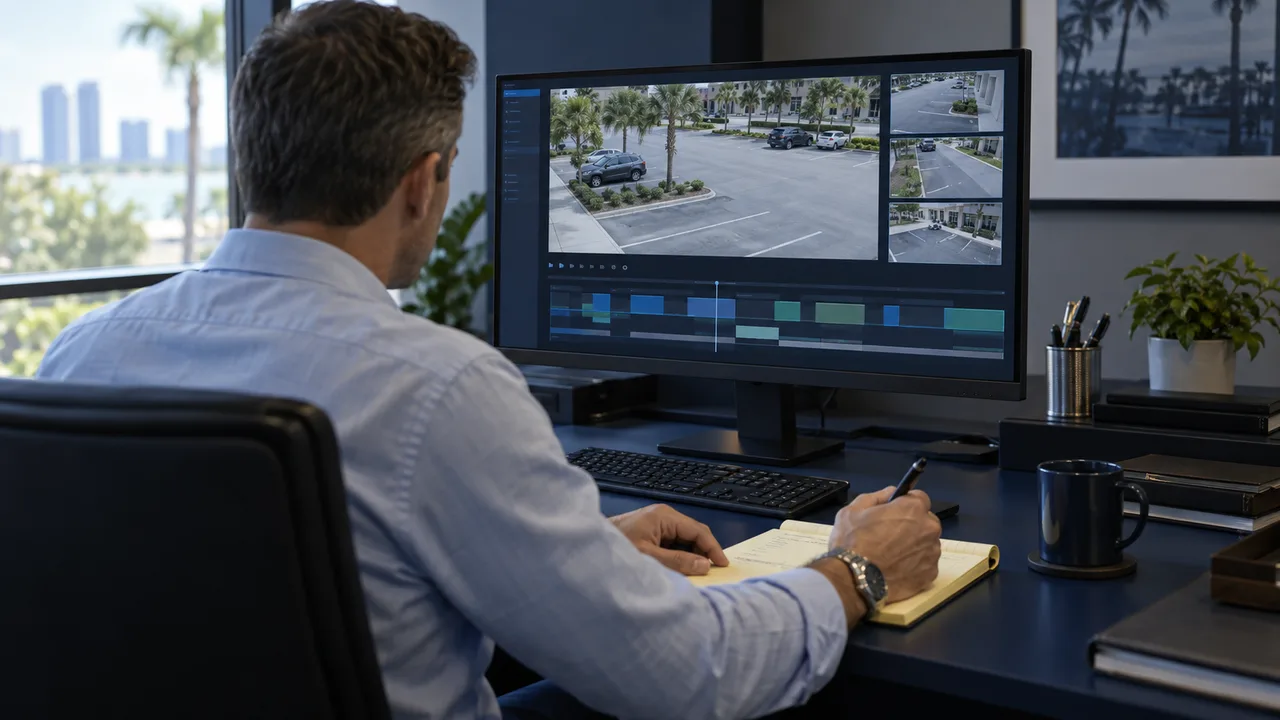
Recorded video becomes more useful when it is organized into a factual chronology. A reviewer should be able to connect an observation to the supporting footage and understand the relevant time period, field of view, and limitations.
Emerging Investigations’ unmanned surveillance division is powered by Covert Captures. Our standard seven-day service includes investigative analyst review of captured footage, a detailed accounting of observed claimant activity at the target location, and report links to activity significant to the investigation.
Where a surveillance platform uses AI or automated event detection, those tools can assist with sorting footage. Human review remains essential to verify the event, assess context, and avoid treating a software flag as a finding. A video clip alone does not establish fraud, medical capacity, intent, or the outcome of a claim.
Why a Sequence Provides More Context
The supplied stills below show different moments involving a wheelchair and a white vehicle. The first shows a woman beside the car holding the wheelchair; the second shows activity at the open rear cargo area with another woman nearby.
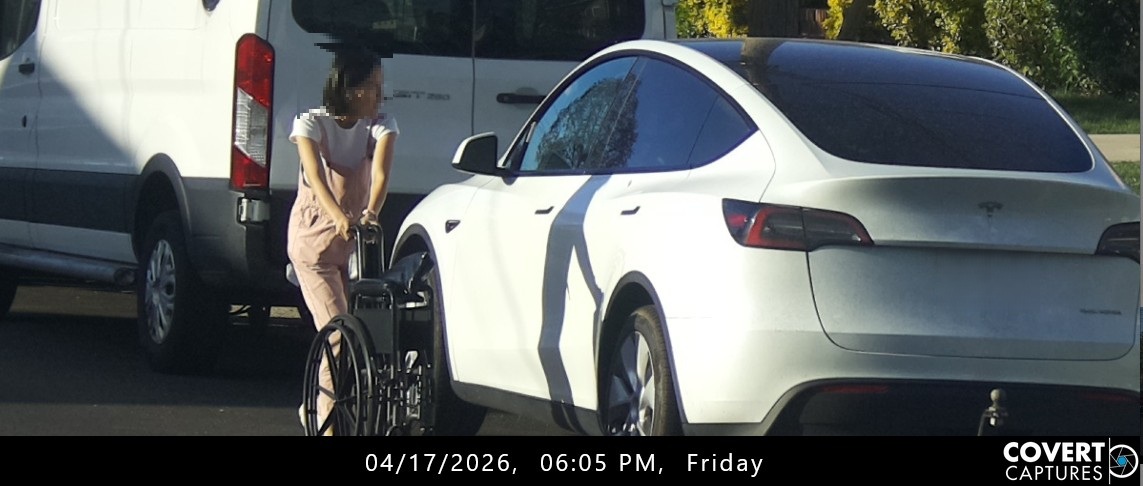
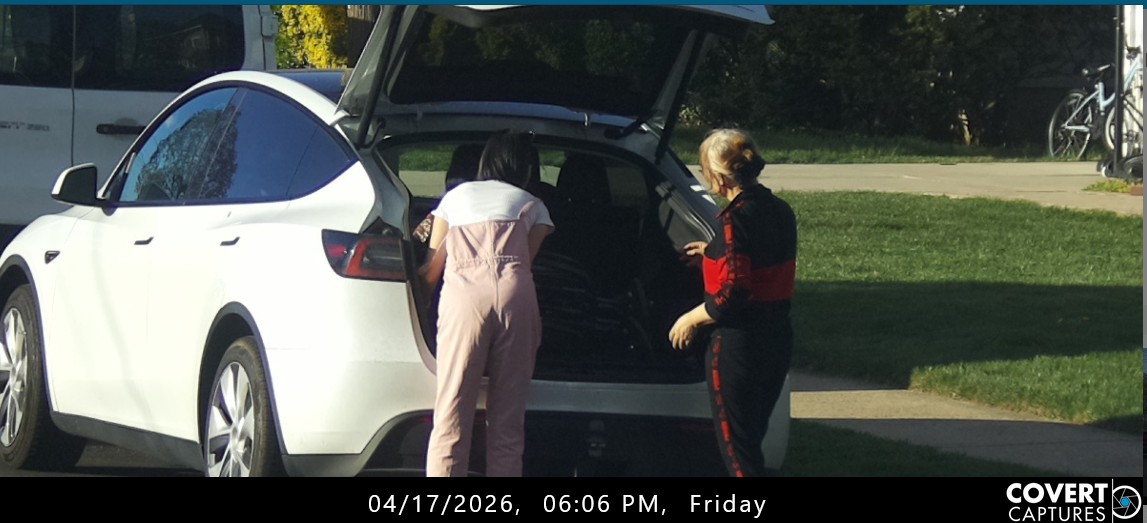
These images illustrate why a report should describe observable actions and connect them to the available sequence. They do not establish a diagnosis, whether assistance was needed at another time, or whether any claim was accurate. Any assessment requires the underlying footage and relevant case context.
Florida Privacy and Evidence Considerations
Lawful camera placement and a defined investigative purpose are central to the assessment. Permission to observe an exterior area does not create unlimited permission to record private spaces. Florida’s digital voyeurism statute, §810.145, addresses prohibited recording in specified private circumstances.
Audio requires separate consideration under Florida’s communications interception statute, §934.03. Emerging Investigations’ unmanned surveillance cameras do not record audio.
For evidence handling, ask how original files, time references, access, transfers, and retention are documented. Florida §90.901 requires authentication as a condition of admissibility; it does not make every surveillance recording automatically admissible. Counsel should assess the requirements of the particular matter.
What Affects Deployment Cost and Timing?
A useful proposal describes the full assignment. Ask about site assessment, installation and removal, equipment, observation duration, analyst review, reports, travel, and any follow-up surveillance. Compare those deliverables with the decision the investigation needs to support.
Location access, camera availability, site conditions, and the scope of work affect when deployment can begin. Agree on the start window and reporting schedule for your assignment instead of assuming that a provider’s general marketing timeline applies to every case.
Before authorizing remote camera deployment, provide the location, investigative objective, relevant dates, intended use of the findings, and any known access or legal restrictions. That information helps determine whether fixed-camera coverage offers a practical next step.
Remote Camera Deployment FAQs
Is remote camera surveillance the same as live monitoring?
No. A system may record footage for later review, transmit it for remote access, or support both. Ask which functions are included and when an analyst reviews activity.
How long does a remote camera deployment last?
The period depends on the assignment. Emerging Investigations’ standard unmanned surveillance service covers seven days. The agreed scope determines the actual observation window and deliverables.
Can an unmanned camera follow someone?
A fixed camera cannot follow someone beyond its field of view. Multiple authorized camera locations or manned surveillance may be appropriate when activity elsewhere matters.
Will the footage prove insurance fraud?
Footage documents visible activity. Whether it supports or contradicts a claim depends on the full record and the relevant facts. No camera system can guarantee a finding of fraud.